
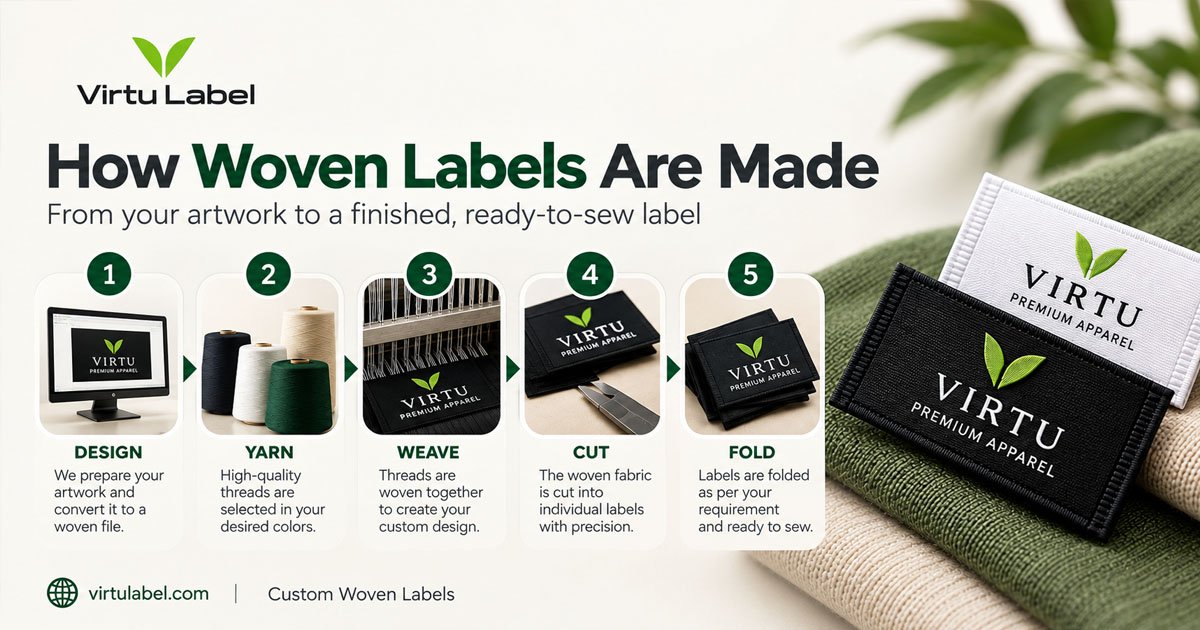
Woven labels are the small fabric tags that give a garment its identity — the brand name in the neck of a shirt, the logo on a pair of jeans. They look simple, but the way they are made is what gives them their sharp detail, durability, and premium feel. Understanding the process helps you order smarter and know what separates a good woven label from a cheap one.
This guide walks through how woven labels are made, step by step, from your artwork to the finished label ready to sew into a garment.
What Makes a Woven Label Different
Unlike a printed label, where ink sits on top of the fabric, a woven label’s design is created by the threads themselves. Coloured yarns are interlaced on a loom so the logo, text, and pattern become part of the fabric. This is why woven labels stay sharp wash after wash and have that structured, high-end feel — the design can’t fade or peel because there is no ink to wear off.
Step 1: Artwork and Design Setup
Everything starts with your artwork. The design — logo, brand name, any text — is prepared digitally and converted into a weaving file that tells the loom exactly where each coloured thread should go.
At this stage the number of colours, the size of the label, and the level of detail are all set. Very fine details and small text need a high-density weave (damask) to stay readable. A good supplier will share a digital proof here so you can approve exactly how the label will look before anything is produced.
Step 2: Choosing Yarns and Colours
Next, the yarns are selected. The base thread (usually polyester for durability) and the colours of your design are chosen and matched to your brand. Colour matching matters: a precise match keeps your label consistent with the rest of your branding across every order.
The type of yarn also decides the label’s feel — a fine, high-count yarn gives the soft, premium hand-feel of a damask label, while a coarser yarn produces a more economical taffeta label.
Step 3: Weaving on the Loom
This is where the label is actually made. The weaving file is loaded into a high-speed loom (often a needle loom or a jacquard loom for detailed designs). The loom interlaces the background threads with the coloured design threads at high density, forming your logo and text directly in the fabric.
Labels are woven in long continuous rolls, with many labels side by side across the width of the loom, which is what makes larger orders efficient and cost-effective. The higher the thread density, the finer the detail — this is the single biggest factor in woven label quality.
Step 4: Cutting
Once woven, the long roll of labels is cut into individual pieces. There are two main cutting methods:
- Heat/straight cut: a hot blade cuts and seals the edge at the same time to stop fraying. It is economical and common for labels folded into a seam.
- Ultrasonic / laser cut: a cleaner, softer edge with no hard ridge, giving a more premium finish — ideal for labels that are visible on the garment.
Step 5: Folding and Finishing
Finally, the labels are folded into the style needed for the garment. Common folds include centre fold (a loop sewn into a seam), end fold (ends tucked under for a neat neck label), and straight cut (flat, no fold). The fold is chosen based on where and how the label will be attached.
After folding, the labels are checked for quality — colour accuracy, clean edges, correct size — then counted, packed, and shipped ready to sew into your garments.
Why the Process Affects Quality (and Price)
Every step influences the final label. Thread density affects detail, yarn quality affects feel, colour matching affects consistency, and cutting and folding affect the finish. A cheap woven label usually cuts corners on density and yarn, which is why it can look fuzzy or feel rough. A well-made label costs a little more but looks and feels premium — and it is the first thing a customer touches when they check who made the garment.
Frequently Asked Questions
How are woven labels made?
Woven labels are made by weaving coloured threads together on a loom so the design becomes part of the fabric. The process runs from preparing the artwork, selecting yarns and colours, weaving on a high-speed loom, cutting the labels, and finally folding and finishing them.
What machine is used to make woven labels?
Woven labels are produced on high-speed looms — usually needle looms, with jacquard looms used for more detailed or intricate designs. The loom interlaces background and coloured threads to form the logo and text.
What material are woven labels made from?
Most woven labels are made from polyester yarn because it is durable and holds colour well. Finer, higher-count yarns produce softer, more premium labels, while coarser yarns make more economical ones.
Why are some woven labels more expensive than others?
Price depends mainly on thread density, yarn quality, number of colours, size, and the cutting and folding finish. Higher density and finer yarn give sharper detail and a softer feel, which costs more but looks far more premium.
How long does it take to make woven labels?
After the design is approved, production typically takes a few days to a couple of weeks depending on quantity and complexity. A digital proof is usually shared before weaving begins so there are no surprises.
Order Custom Woven Labels in Bangladesh
At Virtu Label, we supply custom woven labels for clothing brands and garment factories across Bangladesh and worldwide — handling the full process from your artwork to a finished, ready-to-sew label. We help you choose the right weave, yarn, and fold, share a digital proof before production, and deliver with low minimum order quantities.
Send us your design on WhatsApp at +880 1726439189 for a free quote and a digital proof. We will make sure your woven label looks exactly the way your brand should.
